
If you are preparing to set up a Hindu shrine in your home, you will most likely face a common dilemma: choosing between a Panchaloha deity statue and a Brass deity statue. These two materials are the most mainstream materials for sacred worship statues used in Indian households and temples today. Each carries its own unique spiritual value, aesthetic traits, and long-standing traditional origins, and is suited to completely different usage needs.
What is Panchaloha?
Panchaloha is a sacred alloy that has been used for Hindu statue-making for centuries. The term itself literally means “five metals”, with a standard composition of gold, silver, copper, zinc; only a small number of regional traditional formulas make minor adjustments to this mix.
In Hindu religious belief, this alloy can carry and transmit sacred energy, and the core main deity statues in a large number of India’s thousand-year-old ancient temples are all crafted from this alloy.
What is Brass?
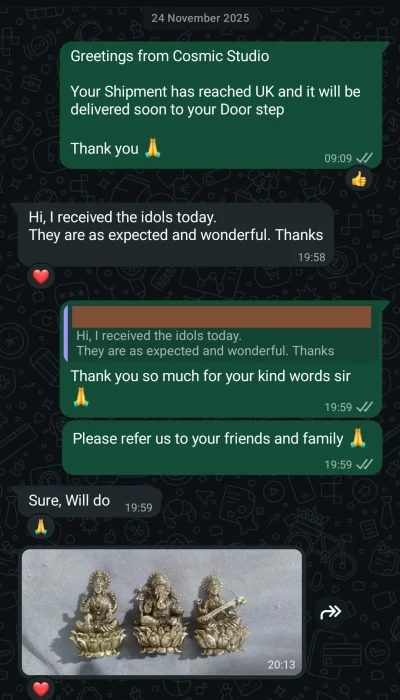
Brass, whose core raw materials are copper and zinc, has become the most widely used material for worship statues today, thanks to its affordable price, excellent durability, and warm, gentle metallic texture. It is applied in nearly all scenarios, including daily household worship, public temple decoration, large-scale festival observances, and religious-themed spiritual gifting.
In recent years, a growing number of families have also chosen to purchase handcrafted brass deity statues online.
Core Differences Between Panchaloha and Brass Idols
This paper sorts out the core differences between the two types of statues across four core dimensions: spiritual significance, appearance and texture, durability, and maintenance difficulty.
I once participated in worship at a relative’s home during the Janmashtami festival and saw a Panchaloha statue of Krishna in person. The quiet spiritual atmosphere that enveloped the entire shrine let me directly experience the unique appeal of this type of deity statue.
Finally, this paper will also clarify the suitable scenarios for each type of statue based on the actual needs of ordinary believers, to provide clear, actionable practical guidance for buyers’ selection.
Understanding Panchaloha Deity Statues
For Hindu devotees planning to set up a home shrine, before purchasing a suitable metal ritual deity statue, it is advisable to first understand the core characteristics of the two mainstream types of these statues.
Panchaloha Deity Statue Care Tips
The first type to introduce is the Panchaloha (five-alloy) deity statue. These statues have unique care requirements, so we have compiled 4 practical cleaning tips to prevent material corrosion and maintain the statue’s luster, to help devotees complete proper daily maintenance.
Panchaloha vs Brass Idols Comparison
Next, we compare the core differences between Panchaloha and brass deity statues across multiple dimensions.
Cost Comparison
First, in terms of cost: Panchaloha statues carry a higher price tag for three reasons: they are crafted from a composite of multiple metals, produced using traditional ancient craftsmanship, and hold extremely high religious and spiritual significance.
By contrast, brass deity statues offer outstanding cost-effectiveness, making them more suitable for novice households that are just setting up their home shrines.
Panchaloha Idol Benefits
Panchaloha statues have four core strengths: they are believed to emit positive spiritual energy, fully align with Hinduism’s thousand-year-old ritual traditions, are made of a durable material that can be passed down through generations of a family, and are suitable for all types of important large-scale sacrificial ceremonies.
Why Brass Idols Are Popular
Brass deity statues remain widely popular today for four reasons as well: they are affordable and easy to purchase, their craftsmanship is equally exquisite and aesthetically pleasing, they are easily accessible through both online and offline sales channels, and they are suited for small, daily household rituals.
Scenario-Based Selection Guide
We have also compiled clear scenario-based selection criteria, explicitly outlining four scenarios where Panchaloha statues are the appropriate choice and four scenarios where brass statues are well-suited.
Pre-Purchase Tips for Buying Metal Idols
We also attach four practical pre-purchase tips: prioritize buying from religious goods vendors with credible qualifications, carefully inspect the statue’s craftsmanship details to avoid defects, select a size that fits the reserved space for your home shrine, and always remember that the core of worship is the sincerity of your own faith.
Final Thoughts
Finally, it should be noted that both types of statues comply with Hindu ritual traditions, and there is no absolute optimal choice. As long as a statue fits your budget, spiritual needs, and usage scenario, it is the most suitable option for you.
The core principle for selecting deity statues for our family’s prayer room is very simple: the statues only need to bring inner peace and positive energy to the household, which meets all our requirements.
Which is better for puja, Panchaloha or brass idols?
Both are suitable for puja, but Panchaloha idols are traditionally considered more spiritually powerful due to the sacred five-metal composition. Brass idols are also widely used for daily worship because they are affordable and easy to maintain.
What are the benefits of Panchaloha idols?
Panchaloha idol benefits include spiritual significance, positive energy, durability, traditional value, and suitability for important Hindu rituals and ceremonies.
Are brass idols good for home temples?
Yes, brass idols are excellent for home temples. They are durable, attractive, budget-friendly, and ideal for daily puja practices.